Thesis
Juhnke, B. (2013) Evaluating the Microsoft Kinect compared to the mouse as an effective interaction device for medical imaging manipulations. Iowa State University. Graduate Theses and Dissertations.
Abstract:
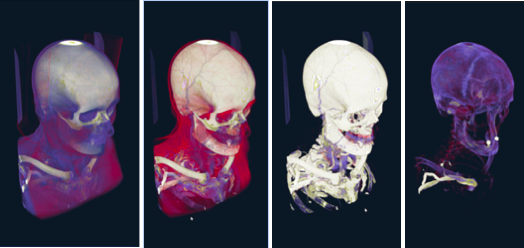
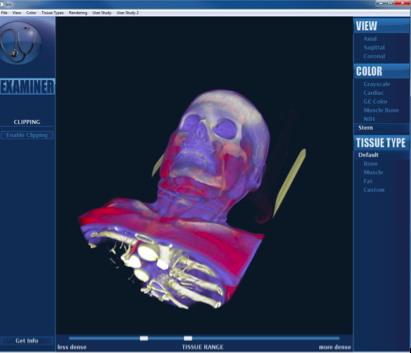
Volume-rendered medical images afford medical professionals increased information to provide their patients with more advanced diagnoses than previously allowed with 2D slices. Three-dimensional (3D) images enable a non-invasive depiction of a patient’s body, that which a surgeon would expect to see through an invasive surgery. These generated 3D representations can more effectively and efficiently convey information about the patient to the surgeon, bypassing the mental reconstruction required by radiologists to interpret the same patient’s data displayed on a two-dimensional (2D) array of images. Time demands on doctors prohibit mastering complicated software packages with steep learning curves. Designs of medical imaging software must be easy to learn with effective functionality for the software to be used and accessible to medical professionals. Interacting with the software is a key component of usability and accessibility. Commercially-off-the-shelf (COTS) interaction devices provide new opportunities to manipulate 3D medical imaging software to further ease a traditionally steep learning curve in medical imaging software. Implementing these devices into medical environments can create new concerns about sterilization and effective utilization. Specific COTS devices offer sterile, touch-less interaction that would be ideal for medical operating rooms (OR), anatomy labs or clinics. These devices allow medical professionals direct control of the patient’s data being examined. This thesis explores the usability and functionality of the Microsoft Kinect as an interaction device for medical imaging technology by being able to complete a task called windowing or changing the tissue densities displayed in an anatomical region. A user study was conducted to evaluate participant’s performance and experience while completing a task called windowing. Windowing is changing the tissue densities displayed in an anatomical image. Participants completed four rounds of five tasks to view particular anatomical features throughout two datasets. Participants using both devices had a 75% accuracy to correctly identify the anatomy, while those using the Kinect (μ = 9.739 minutes) spent on average 2-minutes less time to complete the series of 20 tasks, compared to those using the mouse (μ = 11.709 minutes). Participants using the Kinect also had larger window width values than mouse users, however, this did not appear to affect their accuracy in identifying the tasks.
Publications
Juhnke, B., Berron, M., Philip, A., Williams, J., Holub, J., & Winer, E. (2013, March). Comparing the Microsoft Kinect to a Tractional Mouse for Adjusting the Viewed Tissue Densities of Three-Dimensional Anatomical Structures. In SPIE Medical Imaging (pp 86731M-86731M), Image Perception, Observer Performance, and Technology Assessment.
Escobar, M. M., Juhnke, B., Hisley, K., Eliot, D., & Winer, E. (2013, March). Assessment of visual-spatial skills in medical context tasks when using monoscopic and stereoscopic visualization. In SPIE Medical Imaging (pp. 86730N-86730N). International Society for Optics and Photonics.
Foo, J. L., Martinez-Escobar, M., Juhnke, B., Cassidy, K., Hisley, K., Lobe, T., & Winer, E. (2013). Evaluating Mental Workload of Two-Dimensional and Three-Dimensional Visualization for Anatomical Structure Localization. Journal of Laparoendoscopic & Advanced Surgical Techniques, 23(1), 65-70.
Martinez-Escobar, M., Peloquin, C., Juhnke, B., Peddicord, J., Jose, S., Noon, C., Foo, J. L., & Winer, E. (2011). Development of a Customizable Software Application for Medical Imaging Analysis and Visualization. Medicine Meets Virtual Reality 18: NextMed, 163, 343. Poster: Juhnke-MMVR18_2011
Poster Presentations
Comparing the Kinect™ and Mouse as Interaction Devices for Manipulating Tissue Density in Volume-Rendered Medical Images. Juhnke, B., Berron, M., Philip, A., Williams, J., Holub, J., & Winer, E. International Pediatric Endosurgery Group. 2014 Conference, Edinburgh, Scotland, July 23-25, 2014. Poster: Juhnke-IPEG_2014
A Study Evaluating the Effectiveness of Two-Dimensional and Three-Dimensional Medical Visualization in Anatomy Education” Martinez, M., Juhnke, B., Foo, J.L., Hisley, K., Lobe, T., & Winer, E. International Pediatric Endosurgery Group. 2011 Conference, Prague, Czech Republic, May 5, 2011. Poster: Juhnke-IPEG_2011
Completed coursework
Programming
- Computer Graphics and Geometric Modeling (Mechanical Engineering 557)
- Object-Oriented Analysis and Design (Computer Science 362)
- PHP Web Development (Human Computer Interaction 590)
Statistical Analysis
- Statistical Computing Applications (Statistics 480)
User Experience
- Seminar – Human Computer Interaction 591
- Cognitive Psychology of Human Computer Interaction (Human Computer Interaction 521)
- Human Factors (Industrial Engineering 577)
Design
- Design and Ethics (Human Computer Interaction 589X)
- Virtual Environments, Virtual Worlds, and Applications (Mechanical Engineering 580)
 bethany juhnke